
 Introduction
The Mark degree in Freemasonry, which greatly enhances a Craft Mason’s understanding of operative masonry, has been practised very successfully in Surrey for over 150 years. We currently have over 40 Mark Lodges meeting at centres across the Province.
The Origins of Mark Masonry
It is well known that operative stone masons indented the stones they had prepared with special marks. These were of two types, those that indicated the orientation and position of the stone within the building together with a personal mark to identify the mason who prepared it.
The first mention of a brother being made a Mark Mason was at a Lodge in Newcastle in January 1756, although earlier references to a brother having “received his mark” are known. But it is not clear from these records whether a degree ceremony was being worked.
‘The earliest records of a speculative Mark degree being worked in England are those of Royal Arch Chapter No 257 at Portsmouth on 1 September 1769 when several brethren were made Mark Masons and Mark Masters. It was introduced to the Chapter by that very well known
Masonic figure, Thomas Dunkerley. As to where he obtained it is a matter that merits more detailed investigation. Note that in the earlier working the Mark Man and Mark Master were performed as two distinct degrees as opposed to the present practice of the Mark Man forming no
more than an introductory phase to the Mark Master Degree. It is also apparent from the earlier working that the Mark Man degree was conferred on Fellow Crafts and the Mark Master Degree on Master Masons.
The early Mark Degrees were closely associated with the Royal Arch, as they still are in many parts of the world. ‘Their development probably followed soon after that of the Royal Arch. Many different ceremonies were known to exist, parts of which would be recognisable to the present day.
It is also clear that the Mark Degrees were worked in Craft Lodges and in Royal Arch Chapters up until 1813, The existence of independent Mark Lodges at this time is not known, although one lodge, the Lodge of Hope, Bradford, conferred the Degree under a constitution originating from a body called “The Grand Lodge of All England, held at York” Its influence in this country was confined to York, Cheshire and Lancashire. It was formed in 1725 and existed until 1792 but its influence abroad is more important.
After 1813 the Mark Degree continued to grow in popularity and was worked, unofficially, in Craft Lodges and Royal Arch Chapters — a very unsatisfactory state of affairs.
The eventual establishment of a separate English Grand Lodge of Mark Master Masons in 1856 came after an intriguing period of manoeuvering and negotiation.
The Ceremony in Mark Masonry
The Ceremony is based on the preparations for the building of King Solomon’s Temple and follows the fate of an ambitious craftsman (the candidate) seeking promotion in his trade by demonstrating his skill and ability. In the early part of the ceremony his talents go unrecognised and his hopes and dreams are dashed, but eventually he triumphs over adversity and is justly rewarded for his work.
It is a wonderful ceremony containing elements of drama and humour, but above all strong moral lessons. ‘The concept of Masons as “living stones” being built into a spiritual house, in parallel with the construction of the ‘Temple, is a powerful theme in this Degreee.
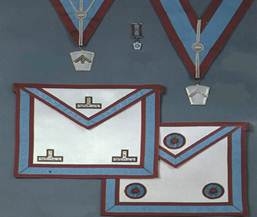 Mark Regalia
‘The regalia worn today was first designed for and worn by the members of the London Bon Accord Mark Lodge in 1856.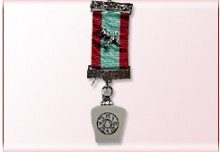
A Mark Master mason wears an apron similar to that of a Master Mason in the Craft except that the Mark Apron is bordered with light blue with crimson edges.
He also wears a breast jewel in the form of a keystone suspended from a ribbon of light blue and crimson.
Qualification for Admission
‘The Structure of Mark Grand Lodge is similar to that of the United Grand Lodge of England. In size of membership the Mark ranks third, after the Craft and the Royal Arch.
Admission requires that a candidate should be a Master Mason of a constitution recognised by the English Craft Grand Lodge.
Why should a Craft Mason be a Mark Mason?
Many reasons could be given but three are of special importance. Firstly, it enhances knowledge of Craft Masonry. Secondly, it teaches, in a delightful way, many important practical lessons about life. Thirdly, it gives a greater appreciation of the Royal Arch and provides a qualification to certain other Orders in Masonry.
For further information please contact the Provincial Grand Secretary email provgsec@markmastermasons.org.uk or visit our web site: www.markmastermasons.org.uk